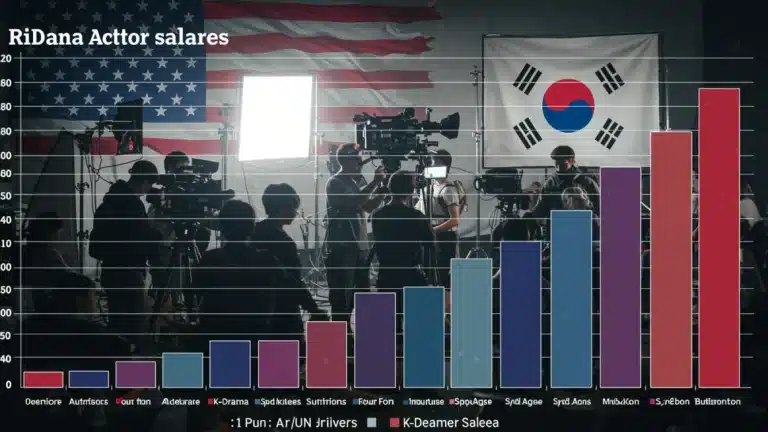
The 2026 K-Drama Actor Salary Report: How Top Stars’ Earnings Impact New Productions in the U.S.
The global entertainment landscape is perpetually shifting, and few sectors exemplify this dynamism as profoundly as the Korean drama (K-Drama) industry. Once a niche cultural export, K-Dramas have exploded onto the international stage, captivating audiences worldwide and significantly influencing global pop culture. As their popularity soars, so too does the financial ecosystem surrounding them, particularly the remuneration of their leading stars. The K-Drama actor salaries in 2026 are not merely numbers; they are powerful indicators of market demand, production values, and strategic investment, especially concerning their burgeoning presence in the United States.
This comprehensive report delves into the intricate details of the 2026 K-Drama actor salary landscape, examining how the skyrocketing earnings of top-tier talent are reshaping production budgets, influencing creative decisions, and, critically, impacting the feasibility and nature of new K-Drama productions specifically targeted for or co-produced with the U.S. market. We will explore the factors driving these salary increases, the disparities between A-list and rising stars, and the ripple effects across the entire industry, from production houses to streaming giants.
The Escalation of K-Drama Actor Salaries: A Global Phenomenon
Over the past decade, the financial profiles of K-Drama actors have undergone a remarkable transformation. What was once a respectable but relatively modest income for even established stars has now ballooned into figures comparable to, and in some cases exceeding, their Hollywood counterparts. This upward trajectory is a direct consequence of several interconnected factors:
Global Demand and Streaming Wars
The advent of global streaming platforms like Netflix, Disney+, and Apple TV+ has been a game-changer. These platforms have not only provided K-Dramas with unprecedented international distribution but have also invested heavily in original Korean content. This fierce competition for compelling narratives and popular stars has driven up production costs, with a significant portion allocated to talent fees. For example, a top-tier K-Drama actor who might have commanded a few tens of thousands per episode a few years ago can now demand hundreds of thousands, sometimes even millions, for a single episode, especially for highly anticipated projects.
The Hallyu Wave’s Continued Dominance
The ‘Hallyu Wave’ or Korean Wave, encompassing K-Pop, K-Dramas, and Korean culture, shows no signs of receding. The immense popularity of K-Drama stars translates into massive fan bases across continents. These actors are not just performers; they are global brand ambassadors, driving merchandise sales, advertising campaigns, and international tours. Their celebrity status directly contributes to the commercial success of a drama, making them invaluable assets that command premium fees.
Increased Production Budgets and Quality
As K-Dramas gain international acclaim, production companies are investing more in high-quality storytelling, cinematography, and special effects. This increased budget often extends to securing top talent, as a well-known lead actor can almost guarantee a certain level of viewership and buzz. The belief is that investing in a bankable star minimizes risk and maximizes potential returns, especially when targeting competitive international markets like the U.S.
The 2026 K-Drama Actor Salary Report: Key Findings
Our analysis for 2026 reveals a clear stratification within the K-Drama acting community regarding remuneration. While the average salary for a working actor remains modest, the earnings of the top 1% are astronomical, creating a significant disparity.
A-List Actors: The Million-Dollar Club
For 2026, the elite group of K-Drama actors, those with a proven track record of international hits and massive fan followings, are commanding salaries upwards of $500,000 to $1 million per episode. In some exceptional cases, particularly for short series or those with immense global pre-sales, this figure can even exceed $1.5 million per episode. Actors like Kim Soo-hyun, Lee Min-ho, Song Hye-kyo, and Jun Ji-hyun continue to be at the forefront of this earning bracket. Their appeal is universal, making them hot commodities for any production aiming for global success, particularly in the lucrative U.S. market.
Mid-Tier Stars: Rising Influence and Negotiating Power
Mid-tier K-Drama actors, those who have established a strong fan base and consistent performance but might not yet have the global recognition of the A-listers, are also seeing substantial increases. Their per-episode fees typically range from $100,000 to $400,000. As the demand for content grows, these actors are increasingly being cast in lead roles, providing them with greater negotiating power. Their salaries are often tied to the success of their previous projects and their social media influence.
Rookie and Supporting Actors: The Foundation
While the headlines focus on the astronomical earnings of the top stars, it’s important to remember the vast majority of K-Drama actors. Rookie and supporting actors, who form the backbone of any production, earn significantly less. Their salaries can range from a few thousand dollars to tens of thousands per episode, depending on their experience, screen time, and agency representation. This disparity highlights the highly competitive nature of the industry and the premium placed on established star power.
Impact on New K-Drama Productions in the U.S.
The soaring K-Drama actor salaries have profound implications for the development and execution of new K-Drama productions, especially those eyeing the U.S. market. The U.S. represents a critical growth area for K-Dramas, not just in terms of viewership but also for potential co-productions and investment.
Increased Production Costs and Budget Allocation
The most immediate and obvious impact is on overall production budgets. When a significant portion of the budget is allocated to securing a top-tier actor, it leaves less for other critical aspects such as special effects, location scouting, marketing, and the salaries of supporting cast and crew. For productions targeting the U.S., which often demand higher production values and more extensive marketing campaigns, this becomes a crucial balancing act. Producers must weigh the star power against the overall quality of the production.

Strategic Casting Decisions
The high cost of A-list K-Drama actors forces production companies to make more strategic casting decisions. Instead of automatically opting for the biggest name, they might consider a rising star with a strong fan base and lower salary demands, or even explore ensemble casts where the collective star power is distributed, rather than concentrated on one individual. This can lead to more diverse and innovative casting choices, potentially introducing new talent to the global stage. For U.S.-focused productions, this might mean a greater emphasis on actors with strong English language skills or those who have already gained some recognition in Western media.
Shift Towards Co-Productions and International Financing
To offset the escalating costs, especially those driven by actor salaries, there’s a growing trend towards international co-productions. U.S. streaming platforms and production companies are increasingly partnering with Korean counterparts to share the financial burden and leverage each other’s expertise and market access. This model allows for larger budgets, potentially accommodating higher actor fees, while simultaneously ensuring broader distribution and appeal. These collaborations often come with stipulations regarding casting, sometimes requiring a mix of Korean and international talent, further influencing salary structures.
Content Strategy and Genre Selection
The financial pressure from high actor salaries can also influence content strategy. Producers might gravitate towards genres that are less reliant on expensive special effects or elaborate sets, focusing instead on strong narratives and character development, where the actor’s performance is paramount. Conversely, for productions aiming for a blockbuster feel in the U.S. market, the investment in a top star might be seen as a necessary evil to attract initial viewership and critical buzz, even if it means a tighter budget for other elements.
The Role of Agencies and Negotiation Tactics
Talent agencies play a pivotal role in the negotiation of K-Drama actor salaries. With the global demand for K-Drama talent, these agencies have become highly sophisticated in maximizing their clients’ earnings. They leverage international appeal, social media metrics, and previous project successes to secure lucrative deals. The negotiation process often involves not just the per-episode fee but also clauses related to international distribution rights, advertising endorsements, and even profit-sharing agreements, especially for productions with significant global potential.
The ‘Star System’ and Its Challenges
While the star system fuels the global popularity of K-Dramas, it also presents challenges. The immense focus on a few top actors can create a bottleneck for talent development, making it harder for new faces to break through. Furthermore, the high salaries can lead to an uneven playing field, where smaller production houses struggle to compete for top talent, potentially limiting their ability to create high-impact, globally appealing content without significant external investment.
K-Drama’s Expansion into the U.S. Market: Opportunities and Obstacles
The U.S. market is a strategic priority for the K-Drama industry. The success of shows like ‘Squid Game’ and ‘Extraordinary Attorney Woo’ on global platforms has demonstrated the immense appetite for Korean content among American audiences. However, adapting and producing K-Dramas for the U.S. involves navigating a complex financial and cultural landscape.
Investment from U.S. Streaming Giants
Netflix, in particular, has made substantial investments in Korean content, recognizing its global appeal. This investment directly contributes to the rising budgets and, consequently, the increasing K-Drama actor salaries. These platforms often act as financiers, allowing Korean production houses to take on more ambitious projects and attract top talent. The U.S. market is not just a consumer; it’s an increasingly important investor and co-producer.
Cultural Nuances and Localization
While the universal themes in K-Dramas resonate globally, successful penetration into the U.S. market often requires careful consideration of cultural nuances. This can involve more than just subtitles or dubbing; it might impact storytelling, pacing, and even casting. The salaries of actors who can bridge these cultural gaps, perhaps with bilingual skills or international acting experience, might see an additional premium.
The ‘Hollywood Effect’ on K-Drama Salaries
As K-Drama actors gain recognition in the U.S., some are also exploring opportunities in Hollywood productions. This cross-pollination further drives up their market value. The exposure gained from a successful Hollywood project can significantly elevate an actor’s standing and, by extension, their salary expectations for future K-Drama roles. This creates a feedback loop where U.S. interest directly contributes to the inflation of K-Drama actor salaries.

Future Outlook: Sustainability and Innovation
The current trajectory of K-Drama actor salaries begs the question of sustainability. While the market can currently bear these high costs due to global demand and streaming platform investments, continuous exponential growth is unlikely. The industry will need to find innovative ways to manage budgets while maintaining high production quality and attracting top talent.
Emergence of New Business Models
We can expect to see the emergence of new business models, perhaps more intricate profit-sharing arrangements, or a greater emphasis on intellectual property (IP) ownership for actors and agencies. Diversification of revenue streams beyond just a per-episode fee, such as brand partnerships tied directly to the drama’s success or global merchandising, could become more prevalent.
Focus on Ensemble Casts and Stronger Storylines
To mitigate the impact of exorbitant lead actor salaries, there might be a greater focus on ensemble casts where the collective strength of multiple talented actors drives the narrative, rather than relying solely on one or two mega-stars. This could also lead to a renewed emphasis on exceptionally strong storylines and innovative concepts that can attract viewers even without a single, overwhelmingly expensive lead.
Talent Development and Nurturing
Investing in and nurturing new talent will be crucial. By developing a broader pool of skilled actors who can command respectable, but not astronomical, fees, the industry can reduce its reliance on a limited number of A-listers. This also creates more opportunities for aspiring actors and ensures a healthy pipeline of talent for future productions.
Conclusion
The 2026 K-Drama Actor Salary Report underscores a dynamic and rapidly evolving industry. The increasing earnings of top K-Drama stars are a testament to their global appeal and the immense value they bring to productions. While these high salaries present challenges for budget allocation and production strategies, especially for new ventures in the U.S. market, they also signify a robust and highly demanded industry.
The interplay between global streaming platforms, the enduring Hallyu Wave, and strategic international collaborations will continue to shape the financial landscape of K-Dramas. As the industry matures, the focus will likely shift towards balancing star power with sustainable production practices, fostering new talent, and ensuring that the captivating storytelling that defines K-Dramas continues to reach and resonate with audiences worldwide, including the ever-growing American fan base. Understanding these financial dynamics is key to comprehending the future trajectory of K-Dramas and their increasing influence on the global entertainment stage, particularly as they deepen their roots in the U.S. market.